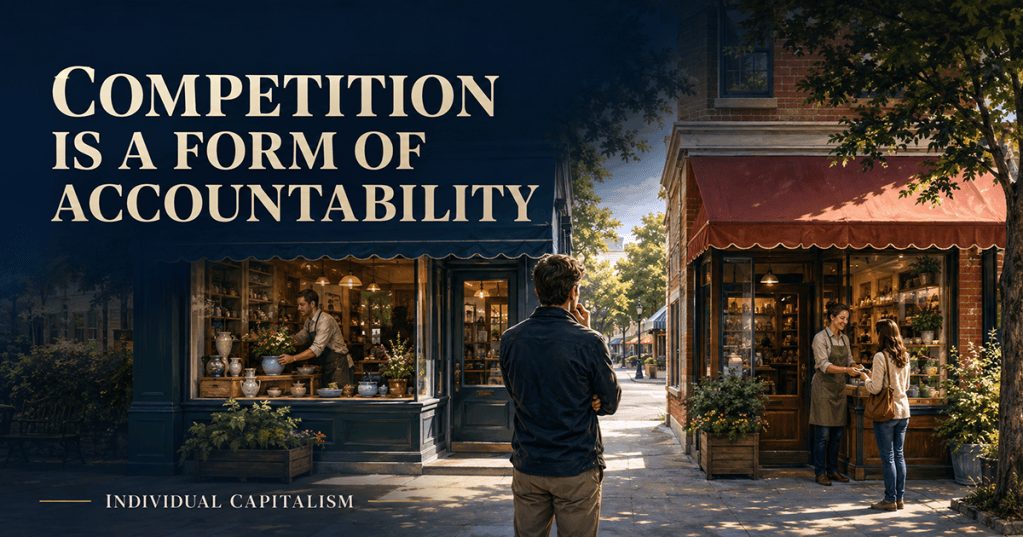
Competition means no producer is automatically entitled to customers. Each must continue earning their business.
In a free market, no business earns your loyalty by right.
A company must earn your business by offering value.
Price matters. Quality matters. Service matters. Trust matters.
If a company disappoints you, you are free to leave.
You may choose another store, another product, another service, or another employer. Your freedom to choose holds every market participant accountable.
Competition gives your dissatisfaction consequences.
A business might ignore a complaint. A business cannot safely ignore thousands of customers who take their money elsewhere.
No government official needs to order the correction. No committee needs to approve the change. Lost sales deliver the message.
Serve people better or lose them.
Competition also holds success to a continuing standard.
A company might produce an excellent product today. Past achievement does not guarantee future customers. Competitors remain free to offer better quality, lower prices, faster service, or a new solution.
Success must be earned again and again.
This accountability applies beyond businesses.
Workers compete by developing their knowledge, judgment, reliability, and skill. Employers compete for capable workers through pay, opportunity, working conditions, and respect. Investors compare risks and returns. Entrepreneurs search for needs others have overlooked.
Everyone faces the judgment of people free to say yes or no.
Such judgment is not always immediate or perfect. Buyers make mistakes. Companies sometimes survive poor decisions. Limited choices sometimes weaken market pressure.
The answer is more freedom to compete.
Government favors, licensing barriers, subsidies, protectionist rules, and special privileges shield established interests from accountability. They make entry harder for new competitors and reduce your choices.
Political protection rewards influence.
Market competition rewards performance.
Competition does not mean hostility. Competitors often respect one another, learn from one another, and raise standards across an industry. Their rivalry gives each participant a reason to improve.
The result benefits you.
You receive more choices. Better products. New ideas. Lower costs. Stronger service. When a seller fails to meet your needs, another person has an opportunity to serve you.
Competition turns freedom of choice into a system of accountability.
You do not need power over a company to influence its behavior. You need the freedom to withdraw your support and give your business to someone else.
Your choice becomes your verdict.
Closing Thoughts: Accountability Through Choice
Competition holds producers accountable to the people they serve.
No business owns your loyalty.
Your freedom to choose keeps every seller answerable to you.
Key Idea
Competition turns freedom of choice into accountability by allowing customers, workers, investors, and entrepreneurs to walk away.
Read Next
A Contract Is a Promise Made Objective
Related Articles
Continue exploring
Individual Capitalism is a connected Library. Follow the next article, explore a Reading Path, or browse the complete collection.

