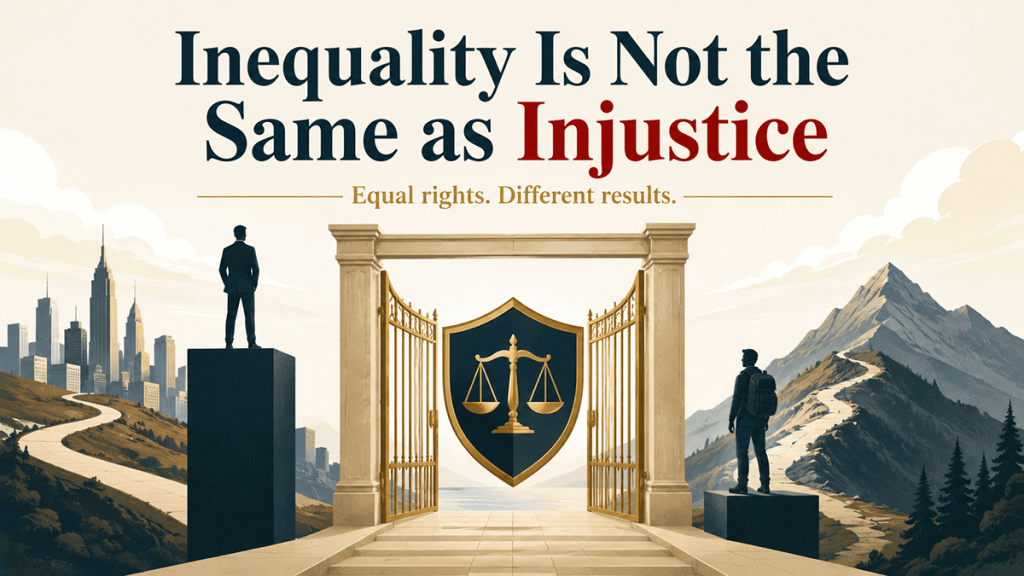
People are unequal in countless ways.
We differ in talent, ambition, health, interests, discipline, judgment, opportunity, luck, and the choices we make.
So we should expect different results.
One person builds a company. Another chooses a quiet career.
One person saves and invests. Another spends more freely.
One person becomes a surgeon. Another becomes a musician, carpenter, teacher, or writer.
Their incomes, possessions, and achievements will differ.
That fact alone tells us nothing about whether an injustice occurred.
Unequal outcomes do not prove injustice. But neither does inequality prove justice.
The question is how those outcomes arose.
The moral question is not: Did everyone end up with the same amount?
The moral question is: Were anyone’s rights violated?
If someone gains wealth through voluntary trade, productive work, investment, invention, or good judgment, another person’s lower income does not make the first person’s success unjust.
If someone gains wealth through fraud, theft, political favoritism, coercion, or special legal privilege, injustice has occurred.
The difference matters.
Equality of rights is a proper principle.
Equality of outcomes is a different idea entirely.
A free society should protect the same basic rights for every person. You should have the same right to own property, make contracts, start a business, choose your work, speak your mind, and pursue your goals as anyone else.
But equal rights do not produce equal lives.
Nor should we expect them to.
Freedom gives people room to choose different paths. Different choices lead to different results.
Even people who begin from similar circumstances often end up in different places because they value different things, take different risks, make different decisions, and pursue different goals.
Trying to force equal outcomes creates a new moral problem.
Someone must decide what everyone deserves.
Someone must decide who has too much.
Someone must decide who receives the difference.
And someone must have the authority to enforce those decisions.
At that point, equality stops being a description of outcomes and becomes an exercise of power.
None of this means every inequality deserves praise.
Some inequalities result from injustice.
Some result from bad laws.
Some result from inherited political privilege, monopoly protection, corruption, discrimination, or force.
Those wrongs deserve opposition because they violate individual rights.
The remedy is justice, not enforced sameness.
A just society does not promise you the same outcome as your neighbor.
It promises something more fundamental.
Your life belongs to you.
Your choices belong to you.
Your property belongs to you.
And the same principle applies to everyone else.
Justice does not require equal results.
It requires equal protection of individual rights.
Key Idea
Unequal outcomes do not prove injustice. The key moral question is whether anyone’s rights were violated.
Read Next
Related Articles
Continue exploring
Individual Capitalism is a connected Library. Follow the next article, explore a Reading Path, or browse the complete collection.

