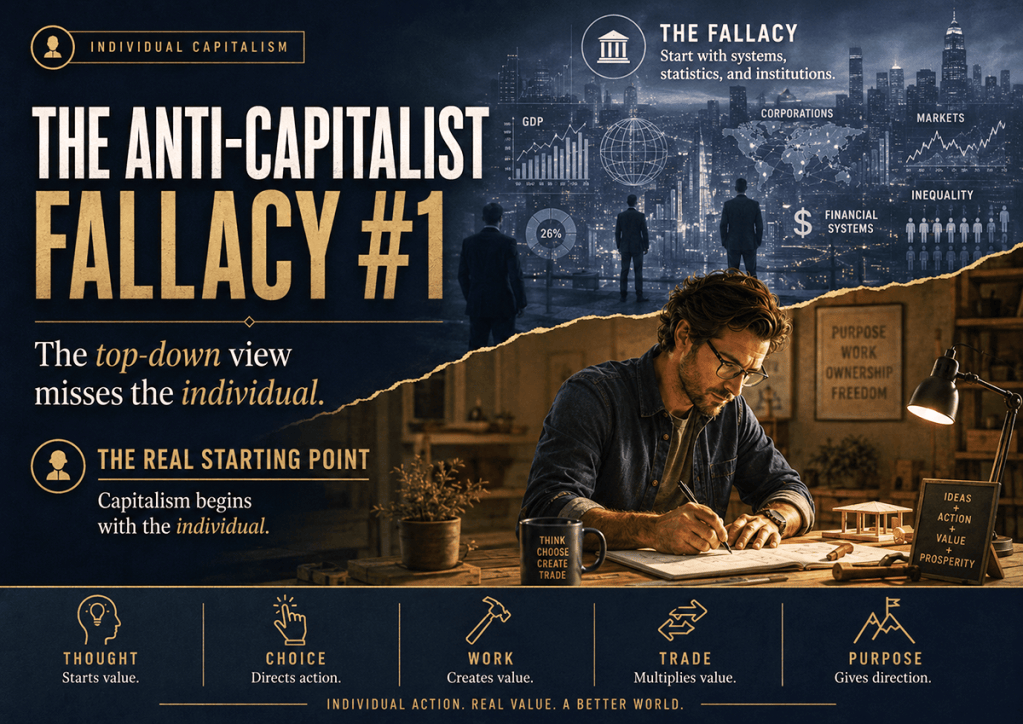
Most critics attack capitalism from 30,000 feet.
They talk about corporations, GDP, inequality, markets, and systems. Then they conclude that capitalism is a cold macro game where the individual gets buried under forces too large to control.
That is anti-capitalist fallacy number 1.
It treats capitalism as if it begins with institutions.
It doesn’t.
Capitalism begins with the individual.
It begins with a person who thinks, chooses, works, creates, trades, saves, invests, builds, and pursues a purpose of his or her own.
The corporation is not the essence of capitalism. The stock market is not the essence of capitalism. GDP is not the essence of capitalism.
Those are consequences, measurements, or institutions.
The essence of capitalism is moral and personal: the freedom of the individual to direct his own life.
That freedom does not guarantee success. It does not promise equal outcomes. It does not remove risk, difficulty, failure, or competition.
But it does protect the conditions under which purposeful individuals can act.
You can develop a skill.
You can start a business.
You can offer value.
You can trade voluntarily.
You can earn, own, save, and improve.
You can rise by judgment, effort, discipline, and productive ambition.
This is what anti-capitalist arguments often miss. They reduce capitalism to distribution, then ignore production.
They condemn unequal results, then overlook unequal choices, efforts, risks, and purposes.
They speak endlessly of society, but rarely of the sovereign individual who must think and act within it.
A free economy is not a guarantee that life will go your way.
It is the recognition that your life is yours to direct.
That is why capitalism matters. Not because it worships money. Not because it serves corporations. Not because it reduces man to a market actor.
Capitalism matters because it leaves the individual free to become the author of his own life.
The real question is not whether capitalism produces perfect outcomes. No system does.
The real question is whether a system protects your freedom to choose, create, trade, and pursue your own purpose.
Capitalism begins where the individual life begins: with the freedom to choose one’s purpose.
Key Idea
Capitalism begins with the individual, not with aggregate institutions, statistics, or corporations.
Read Next
Related Articles
Continue exploring
Individual Capitalism is a connected Library. Follow the next article, explore a Reading Path, or browse the complete collection.

