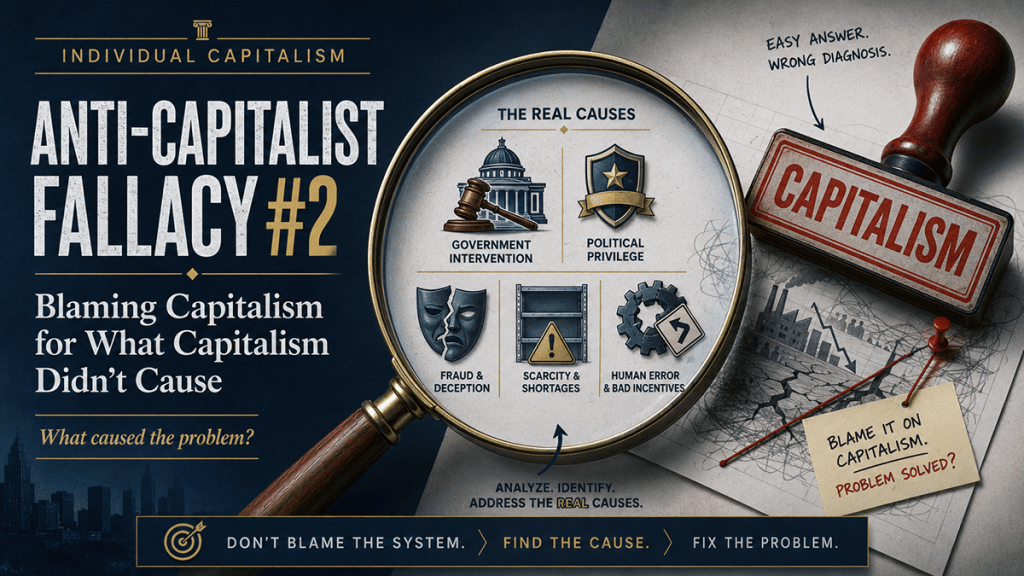
Most people blame capitalism the moment something goes wrong in the economy.
Prices rise.
A company cheats.
A market gets distorted.
A crisis occurs.
A politically connected firm gets rich.
The verdict arrives before the diagnosis:
“Capitalism failed.”
But that skips the most important question:
What caused the problem?
This is Anti-Capitalist Fallacy #2: blaming capitalism for what capitalism didn’t cause.
Fallacy #1 dealt with definition. It challenged the habit of viewing capitalism from 30,000 feet through corporations, GDP, inequality, and aggregate outcomes while forgetting the individual who thinks, chooses, produces, owns, trades, and pursues a purpose.
Fallacy #2 deals with diagnosis.
Not every problem inside a mixed economy is a failure of capitalism.
A mixed economy contains voluntary exchange, private ownership, production, trade, and competition. But it also contains subsidies, bailouts, regulatory capture, political privilege, monetary manipulation, licensing restrictions, tariffs, zoning laws, fraud, corruption, and barriers that keep competitors out.
Those are not the same thing.
If a company wins through better products, lower prices, and voluntary customers, that is capitalism at work.
If a company wins through political favors, protected status, bailouts, mandates, or regulations written to crush smaller competitors, that is cronyism.
If prices rise because demand exceeds supply, that is scarcity.
If prices rise because policy restricts supply, expands money, blocks building, or punishes production, that is intervention.
If a business lies, steals, or defrauds customers, that is fraud.
If individuals make bad decisions, misjudge risk, or follow destructive incentives, that is human error.
None of these should be waved away. They matter.
But they should be named accurately.
Before blaming capitalism, identify the causal mechanism.
Did voluntary exchange produce the problem?
Did private ownership produce it?
Did open competition produce it?
Did production and trade produce it?
Or did coercion, privilege, intervention, scarcity, fraud, bad incentives, or human error produce it?
This distinction matters because a false diagnosis leads to a false cure.
If political privilege caused the harm, more political control won’t solve it.
If restrictions on competition caused the harm, attacking markets won’t solve it.
If monetary policy distorted prices, condemning private ownership won’t solve it.
If fraud caused the harm, the answer is legal accountability and restitution — not condemning capitalism or replacing voluntary exchange with collective control.
A serious critic of capitalism must do more than point to a bad outcome and assign blame.
He must show that the outcome was caused by the essential features of capitalism: individual rights, private property, voluntary exchange, production, trade, and competition.
Without that causal link, the argument collapses.
Capitalism should be judged by what capitalism is, not by every distortion that occurs in a system already compromised by coercion and privilege.
The question is not, “Did something bad happen in an economy that contains markets?”
The question is, “What produced the bad outcome?”
Before we compare systems, we have to diagnose causes.
Key Idea
Before blaming capitalism, identify the cause and distinguish markets from coercion, privilege, intervention, fraud, scarcity, and human error.
Read Next
Anti-Capitalist Fallacy #3: Comparing Capitalism to an Imaginary Alternative
Related Articles
Continue exploring
Individual Capitalism is a connected Library. Follow the next article, explore a Reading Path, or browse the complete collection.

