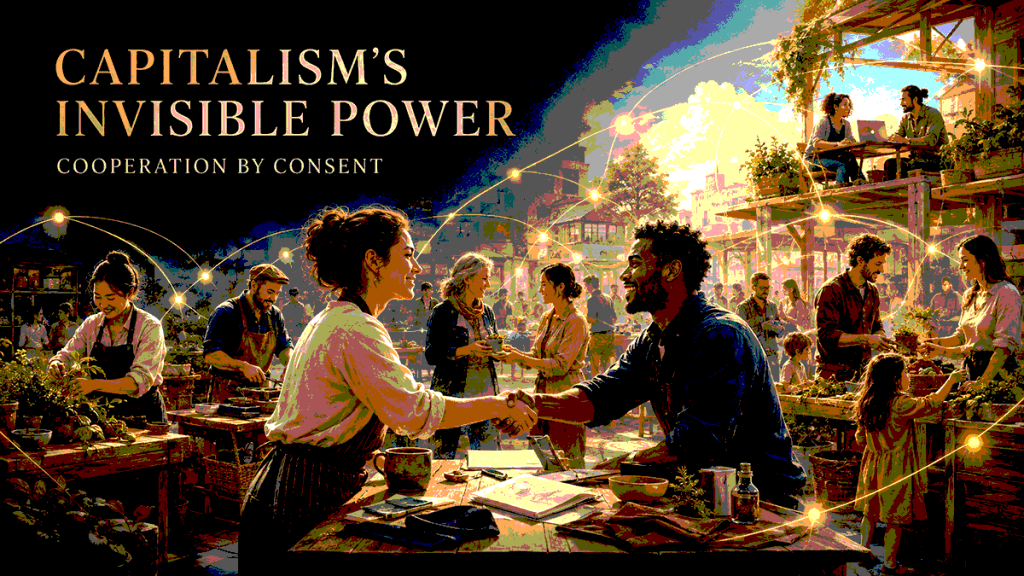
“Capitalism is based on self-interest and self-esteem; it holds integrity and trustworthiness as cardinal virtues and makes them pay off in the marketplace, thus demanding that men survive by means of virtues, not of vices.” — Ayn Rand, Capitalism: The Unknown Ideal
Even the most rugged individual depends on cooperation — with suppliers, mentors, clients, family, and friends.
But cooperation must be voluntary to be moral.
Capitalism fosters this.
It invites people to cooperate not by command, but by consent.
Think about a marketplace: goods and services flow not because anyone is forced, but because everyone is free to choose.
That freedom unleashes ingenuity. It matches talent to need. It forms networks, companies, teams, and movements.
No central planner could orchestrate it. No bureaucracy could substitute for it.
Voluntary cooperation builds trust. It rewards honesty. It creates value.
It’s not perfect. People will still err. But they are free to correct course without waiting for permission.
Capitalism is not chaos. It is spontaneous order.
And the engine of that order is voluntary human action.
Closing Thoughts: Power of Voluntary Cooperation
Capitalism fosters cooperation not by command, but by consent.
True cooperation is consent in action.
In voluntary exchange, trust is built, value is created, and freedom becomes order.
Key Idea
Voluntary human action turns independent choices into cooperation and spontaneous order.
Read Next
Related Articles
Continue exploring
Individual Capitalism is a connected Library. Follow the next article, explore a Reading Path, or browse the complete collection.

