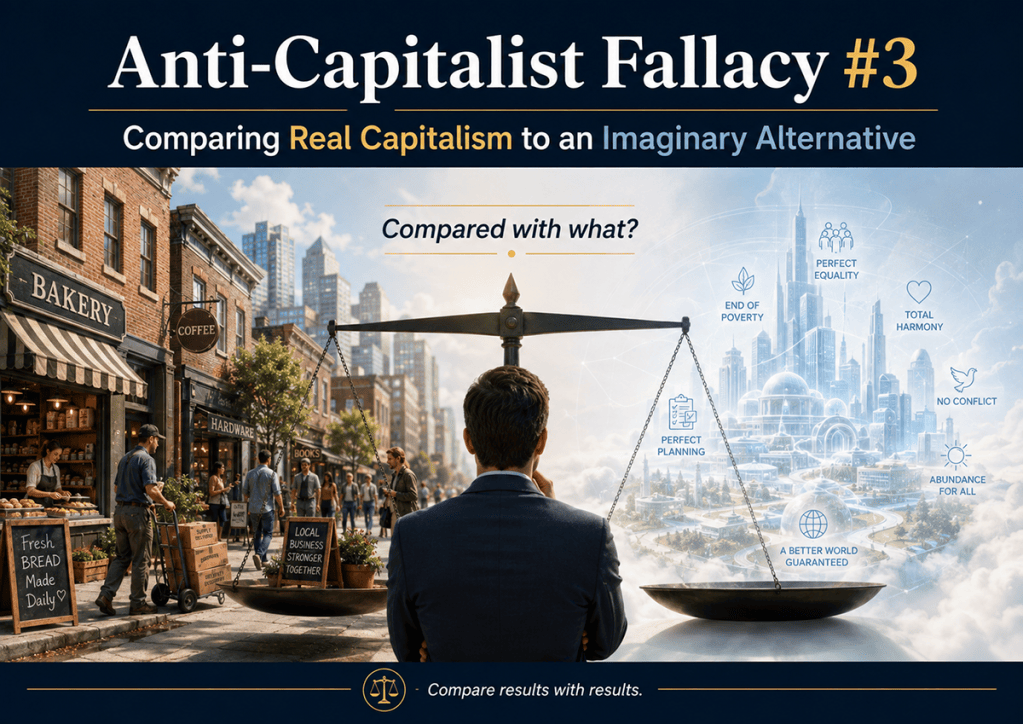
Question: Compared with what?
Critics of capitalism have an advantage they should not be allowed to keep.
They compare capitalism as it exists, with all its mistakes, failures, inequalities, bad actors, and disappointments, against an alternative that exists largely in theory.
Capitalism must answer for every flaw.
The alternative gets judged by its intentions.
That is Anti-Capitalist Fallacy #3.
If you want to judge capitalism fairly, compare real systems with real systems.
Start with socialism.
The historical record gives us the Soviet Union, China under Mao, Cuba, North Korea, Venezuela under Chávez and Maduro, and numerous less extreme experiments with state ownership and economic planning.
The results differed from country to country. The degree of repression differed. The economic policies differed.
But the record matters.
You cannot dismiss decades of experience and then announce that the next version will work because this time we will do socialism correctly.
That brings us to “democratic socialism.”
The term often performs an interesting function. It separates the proposed system from the failures associated with older socialist regimes.
This version, advocates tell us, will be democratic. People will vote. Civil liberties will remain. Government will act peacefully through elections and legislation.
Fine.
But democracy answers one question: How are political leaders chosen?
It does not answer another: How will the economy work?
Who will own businesses?
Who will allocate capital?
Who will determine prices?
Who will decide what gets produced?
Who will bear losses?
What happens when consumers want something planners did not anticipate?
What prevents political power from becoming economic power?
Calling a system democratic does not eliminate scarcity, incentives, conflicting interests, limited knowledge, or human fallibility.
Those problems remain.
Then there is Scandinavia.
Sweden, Denmark, Norway, and Finland often appear in arguments for socialism.
But these countries do not provide examples of economies that abolished capitalism. They combine extensive welfare programs and high taxation with private businesses, private property, market prices, entrepreneurship, investment, and international trade.
They are mixed economies.
So is the United States.
America does not practice pure laissez-faire capitalism. Government taxes, regulates, subsidizes, restricts, redistributes, licenses, mandates, and operates major programs throughout the economy.
That distinction matters.
When something goes wrong in a mixed economy, you must first ask what caused it. That was Fallacy #2.
Fallacy #3 asks the next question. What system are you comparing the result with?
This becomes especially important when critics promise greater equality, greater security, a larger “fair share,” or less economic power for the wealthy.
Those promises sound attractive to many people.
But promises are not results.
How would the proposed system produce those outcomes?
What incentives would people face?
What new powers would government acquire?
What unintended consequences might follow?
What happens if the policy fails?
And who pays for the mistake?
Capitalism deserves no exemption from criticism.
Businesses fail. Executives make foolish decisions. Investors misjudge markets. Consumers make mistakes. Some people become wealthy while others struggle. Fraud occurs. Economic disruption hurts people.
Capitalism operates through fallible human beings.
So does every alternative.
That is the point critics often overlook.
The alternative to imperfect capitalism is not perfect socialism.
That alternative is another system operated by the same imperfect human beings, facing the same scarcity, incomplete knowledge, competing interests, and uncertain future.
The comparison therefore has to change.
Do not compare capitalism’s results with socialism’s promises.
Compare results with results.
Compare incentives with incentives.
Compare institutions with institutions.
Compare freedom with coercion.
Compare how each system handles failure.
Compare how much power each places in the hands of individuals and how much it transfers to government.
Then ask the question that exposes the fallacy:
If you reject capitalism, what is your alternative?
And where has it worked?
“Compared with what?” may be one of the most important questions you can ask in any debate about capitalism.
Sources & Notes
The factual and historical claims in this article were checked against the following sources. The interpretation and argument are the author’s.
- Democratic Socialists of America: What Is Democratic Socialism?
- Nordic Cooperation: The Economy in the Nordic Region
- Library of Congress: Internal Workings of the Soviet Union
- World Bank: China
Key Idea
Judge real systems against real alternatives, using institutions, incentives, results, freedom, and power rather than promises.
Read Next
Down to Earth with Capitalism and Socialism
Related Articles
Continue exploring
Individual Capitalism is a connected Library. Follow the next article, explore a Reading Path, or browse the complete collection.

