For decades, China has provided one of history’s largest economic experiments.
The lesson deserves attention from both defenders and critics of capitalism.
Under Mao Zedong, China operated under extensive central planning, collectivized agriculture, state ownership, and severe restrictions on private economic activity.
After Mao’s death, Deng Xiaoping moved China in a different direction.
Beginning in 1978, China gradually expanded private initiative, market pricing, foreign investment, trade, profit incentives, and non-state enterprise, while retaining a large state-owned sector.
The results were enormous.
According to the World Bank, China’s economy grew by more than 9 percent a year on average after reforms began. Nearly 800 million people rose out of extreme poverty.
Early reforms produced especially large gains. Farmers received greater control over production. Price controls declined. Non-state businesses expanded. Foreign investment poured into special economic zones. Markets increasingly replaced government planners in allocating resources.
China did not become a free capitalist society.
The Communist Party kept political power firmly in its hands. State ownership remained important. Government maintained major influence over banking, investment, strategic industries, land, and economic policy.
China became a mixed system, with markets and private enterprise operating inside boundaries established by a one-party state.
This distinction matters.
China’s economic success accelerated when the government gave individuals greater freedom to produce, trade, invest, compete, and profit.
But economic freedom never gave Chinese entrepreneurs political independence.
Jack Ma provides the most famous example.
Ma built Alibaba into one of the world’s largest technology companies. In October 2020, he publicly criticized China’s financial regulatory system.
Days later, regulators stopped Ant Group’s planned $37 billion stock offering. Authorities launched an antitrust investigation into Alibaba and forced major changes at Ant. Ma then disappeared from public view for about three months and remained largely outside public business life for years.
Ma’s case requires precision. He attacked financial regulation. He did not launch a direct political attack on Xi Jinping or Communist Party rule.
Other entrepreneurs went further.
Real estate executive Ren Zhiqiang became known for criticizing the Party. In 2020, after an essay widely attributed to him attacked the government’s handling of COVID-19 and appeared to mock Xi, authorities detained him. A court later sentenced him to 18 years in prison on corruption charges.
Entrepreneur Sun Dawu offers another example. Sun supported liberal intellectuals and pro-democracy causes and openly criticized government policies. Authorities arrested him in 2020. He received an 18-year prison sentence in 2021 on charges involving illegal fundraising, obstruction of public service, and other offenses. His supporters and lawyers argued political motives played a major role. The Chinese government rejected claims of a campaign against private business.
These cases reveal the deeper problem.
You are free to become wealthy, until your influence collides with political authority.
You are free to build a company, but political power establishes the boundaries.
You possess economic freedom at the government’s discretion rather than as an inviolable individual right.
China still needs its entrepreneurs. Xi Jinping met with major private business leaders, including Jack Ma, on February 17, 2025, as Beijing sought stronger growth and technological innovation. The meeting signaled renewed official support for private enterprise.
The pattern tells us something important about capitalism.
Markets work because individuals make decisions.
Entrepreneurs identify opportunities. Investors risk capital. Workers pursue better opportunities. Customers choose. Prices transmit information. Profit rewards value creation. Loss exposes mistakes.
China received enormous benefits from allowing more of those activities.
But Individual Capitalism requires something deeper than government permission to earn money.
Your property must belong to you.
Your business must belong to you.
Your choices must receive protection from arbitrary political interference.
Your success must not depend on remaining politically acceptable.
China’s history since 1978 therefore offers two lessons at once:
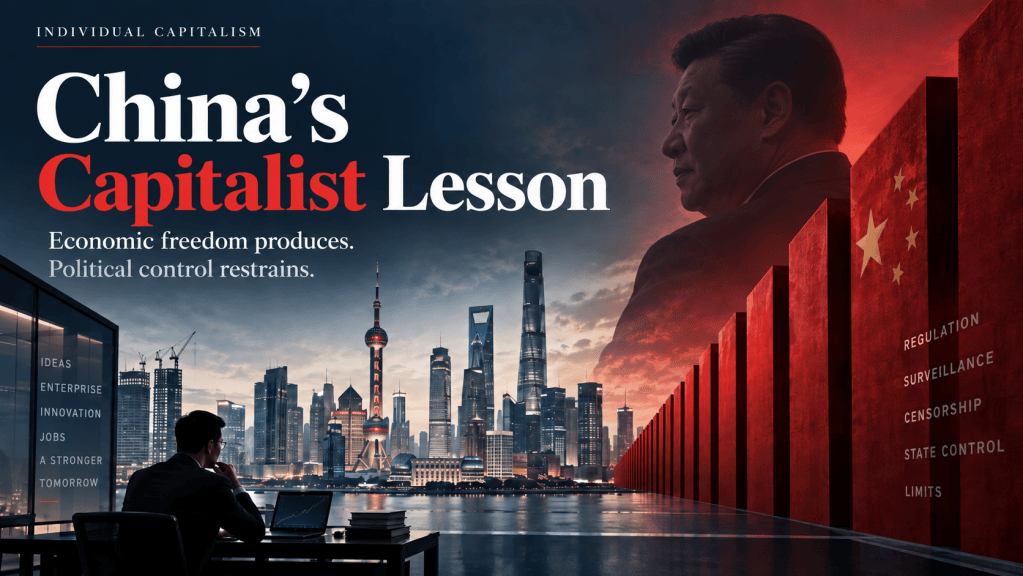
Economic freedom produces prosperity.
Political power places limits on freedom.
China moved away from Maoist economic control and became dramatically richer.
But China never moved fully to Individual Capitalism.
The entrepreneur gained room to act.
The Communist Party kept the power to decide how much room he would have.
China’s experience offers a clear lesson. Markets, private initiative, and profit helped create extraordinary growth. Yet prosperity without secure individual rights leaves freedom vulnerable to political power.
Individual Capitalism requires both economic liberty and protection from arbitrary state control.
Sources & Notes
The factual and historical claims in this article were checked against the following sources. The interpretation and argument are the author’s.
- World Bank: China growth and poverty reduction since 1978
- Reuters: Jack Ma’s public absence after the Ant IPO suspension
- Reuters: Sun Dawu, Ren Zhiqiang, and pressure on prominent business figures
- Reuters: Xi’s February 17, 2025 meeting with private-sector leaders
Key Idea
China illustrates both the productive power of greater market freedom and the vulnerability of economic liberty without secure individual rights.
Read Next
Capitalist Intellectual Self-Defense
Related Articles
Continue exploring
Individual Capitalism is a connected Library. Follow the next article, explore a Reading Path, or browse the complete collection.

