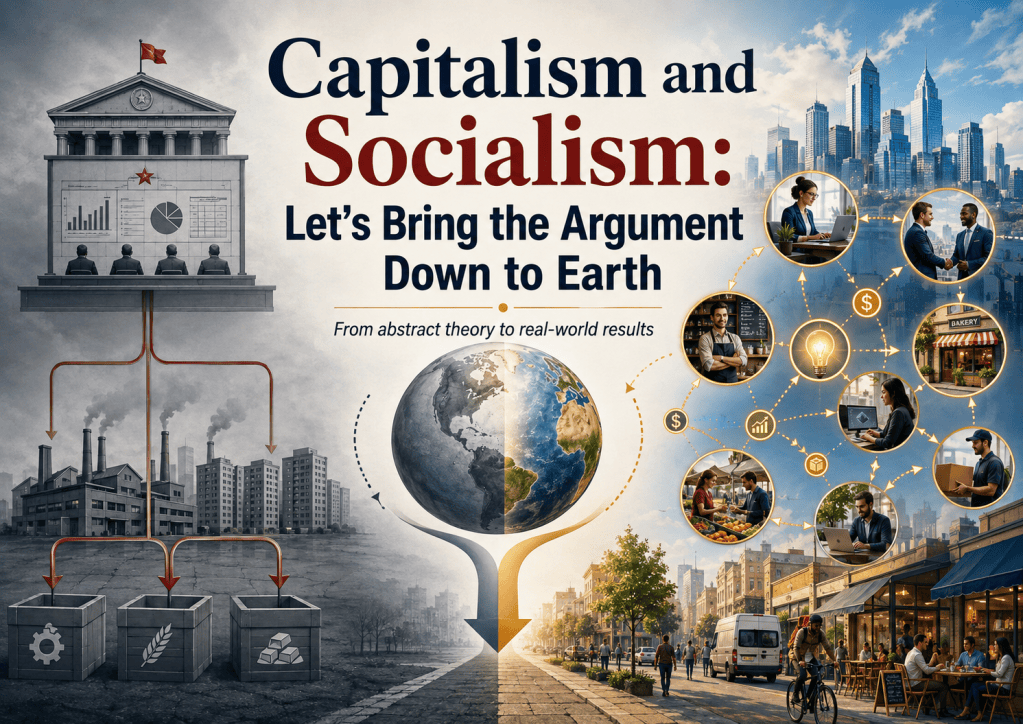
Capitalism begins with the individual. Socialism begins with the collective.
A reader challenged me to move beyond principle and look at countries, history, policy, and results.
Fair enough.
So let’s bring the argument down to earth.
Start with an Important Concession: No major modern economy operates as pure capitalism.
The United States has Social Security, Medicare, public schools, regulation, subsidies, a central bank, and thousands of other government programs.
Denmark, Sweden, Switzerland, the Netherlands, Germany, and others combine extensive social programs with private business and markets.
Calling these countries “mixed economies” is accurate. But the phrase raises a deeper question.
What exactly is being mixed:
- Private ownership with government control.
- Voluntary exchange with compulsory taxation.
- Market prices with political decisions.
- Private investment with public spending.
- Entrepreneurial risk with government subsidy.
- Individual choice with collective direction.
Calling an economy mixed does not erase the principles being mixed.
The important question becomes: Which side of the mixture produces the wealth?
Look at the Nordic Countries
Denmark and Sweden often appear in arguments for socialism. Yet both countries rely heavily on private ownership, competitive businesses, international trade, market prices, entrepreneurship, and private investment.
Volvo, IKEA, Novo Nordisk, Maersk, Ericsson, Lego, Spotify, and many other firms did not emerge from socialist central planning. They grew through markets.
Nordic governments tax and redistribute large portions of national income. Their welfare systems are extensive.
But redistribution requires something to redistribute.
Before government spends wealth, someone must produce wealth. This distinction matters.
A welfare state supported by a capitalist economy is not proof of socialism’s productive success.
The Soviet Experiment
Now consider a system built far more directly around socialist principles. The Soviet Union nationalized major industries, restricted private ownership, replaced market allocation with central planning, and directed production through government institutions.
The result was not simply political repression.
Economic calculation suffered. Planners had to decide what to produce, how much to produce, where resources should go, and which goods deserved priority. Without genuine market prices for much of the economy, planners lacked the information millions of buyers and sellers generate through voluntary exchange.
Shortages became common. Surpluses appeared where demand was weak. Quality often suffered. Consumers waited for ordinary goods Western shoppers took for granted.
The Soviet Union achieved major accomplishments in selected areas, especially military production, heavy industry, science, and space.
A command system concentrates resources when political leaders choose a narrow objective.
But producing missiles differs from satisfying millions of changing consumer preferences.
By 1991, the Soviet system collapsed.
East Germany and West Germany
Postwar Germany offers a useful historical comparison.
Germany split into two political and economic systems after World War II. West Germany adopted a market-oriented economy with private property and competitive enterprise. East Germany adopted socialist central planning under communist rule.
Both populations shared language, history, culture, and much of their prewar institutional background. Their economic paths diverged.
West Germany became one of the world’s leading industrial economies.
East Germany struggled with lower productivity, fewer consumer goods, weaker innovation, and lower living standards. People did not flee West Germany for East Germany. The Berlin Wall went up largely to stop movement in the opposite direction.
North Korea and South Korea
The Korean peninsula offers another natural comparison.
North Korea developed under communist central planning and state ownership. South Korea moved toward private enterprise, markets, international trade, and investment.
South Korea became a major producer of automobiles, electronics, ships, semiconductors, and consumer technology. North Korea became one of the poorest and most repressive countries on earth.
The two Koreas share deep geographic, cultural, and historical roots, making their divergence especially instructive. They also experienced different alliances, policies, and historical conditions, so no single factor explains the entire gap. Institutions still matter greatly.
China’s Turn Toward Markets
China offers an equally revealing case.
Under Mao, China imposed collectivized agriculture, state ownership, central planning, and severe restrictions on private economic activity.
The Great Leap Forward produced economic disaster and mass famine.
After Mao’s death, Deng Xiaoping introduced reforms beginning in the late 1970s.
Farmers received greater control over production. Private enterprise expanded. Foreign investment entered. Market pricing grew. Trade expanded.
The economic direction changed.
As China allowed more private initiative and market activity, production and incomes rose on a scale few countries had ever experienced. The lesson deserves attention. China’s dramatic economic rise followed movement away from Maoist economic control and toward markets.
But China did not become a free capitalist society.
Political control stayed firmly in Communist Party hands.
Jack Ma’s experience shows what this means in practice.
In October 2020, the Alibaba founder publicly criticized China’s financial regulatory system.
Soon afterward, Chinese regulators halted the planned $37 billion public offering of Ant Group, launched an antitrust investigation into Alibaba, and ordered major changes to Ant’s operations. Ma then largely disappeared from public view for several months. The sequence became a prominent example of the limits political power can place on even highly successful private entrepreneurs.
The episode exposed a basic tension within China’s economic model.
Entrepreneurs received greater freedom to build businesses, innovate, invest, and create enormous wealth, but their independence had political limits. Economic success did not place them beyond the authority of the Communist Party. China welcomed entrepreneurial energy as long as political power retained the final word.
Why Markets Work Better
Capitalism has an advantage no planning agency possesses.
- Millions of individuals possess local knowledge.
- One business owner knows what customers are asking for.
- One worker knows which skill is becoming more valuable.
- One investor sees an opportunity others missed.
- One consumer decides a product costs too much.
- One entrepreneur sees a better method.
- Prices transmit information from these separate decisions.
- Profit rewards successful value creation.
- Loss punishes mistakes.
Competition pressures producers to improve.
Consumers retain the power to walk away.
No central planner knows everything. No central plan coordinates every choice.
People coordinate through exchange.
But What About Capitalism’s Failures?
Capitalist societies have recessions, fraud, inequality, corporate failures, pollution, unemployment, bad investments, monopolistic behavior, and financial crises.
None deserves dismissal. A serious defense of capitalism must examine each problem. But diagnosis matters.
Was the problem caused by voluntary exchange?
Fraud is not capitalism.
Political favoritism is not free enterprise.
Government-created monopoly is not market competition.
A bailout transfers risk from private decision-makers to taxpayers. A subsidy distorts market signals. A regulation sometimes solves a problem and sometimes creates another.
A mixed economy makes causal analysis harder because market forces and political intervention operate together.
This is why blaming every bad outcome in a capitalist country on capitalism proves little. The same standard should apply to socialism.
Judge each system by the institutions responsible for the result.
What About Social Security, Medicare, and Public Schools?
Supporters of mixed economies often point to popular government programs. Those programs raise legitimate policy questions. But their existence does not settle the larger argument.
Social Security does not manufacture cars. Medicare does not produce pharmaceuticals. Public schools do not create the tax base supporting their budgets.
Government programs depend on an underlying productive economy.
This does not prove every government program is wrong.
The point is narrower.
Redistribution and public spending depend on prior production.
Wealth must exist before government spends or redistributes wealth.
The Moral Question Still Matters
Even strong economic results do not settle every issue. Suppose a government program produces a measurable benefit. Another question still remains.
What powers should government possess over your property, income, work, contracts, and choices?
Economic policy involves more than aggregate statistics. People live underneath those statistics.
Individuals earn the income. Individuals build the businesses. Individuals invent the products. Individuals take the risks. Individuals make the trades. Individuals bear the consequences.
A society should care about prosperity. A free society should also care how prosperity is achieved.
The Pattern Is Hard to Ignore
Across many different cultures and historical periods, a broad pattern appears.
Greater economic freedom tends to encourage production, entrepreneurship, investment, innovation, and rising living standards.
Greater centralized control tends to weaken market signals, reduce incentives, politicize economic decisions, and restrict individual choice.
Mixed economies complicate the picture. They do not erase the distinction.
The practical debate should ask how much government intervention produces benefits worth the economic and moral costs.
The philosophical debate goes deeper.
Who owns your life? Who owns your work? Who decides what you produce? Who decides what risks you take? Who decides whom you trade with?
My answer remains the same.
You do.
And from that principle, capitalism begins.
Sources & Notes
The factual and historical claims in this article were checked against the following sources. The interpretation and argument are the author’s.
- U.S. State Department Historian: The Berlin Crisis, 1958–1961
- IMF: German Reunification and the East-West Economic Gap
- OECD Economic Survey: Korea 2026
- World Bank: China
- Reuters: Jack Ma’s public absence after the Ant IPO suspension
Key Idea
Real-world comparison requires asking which institutions produced which results, especially inside mixed economies.
Read Next
China’s Economic Rise and the Price of Political Control
Related Articles
Continue exploring
Individual Capitalism is a connected Library. Follow the next article, explore a Reading Path, or browse the complete collection.

