Most debates about socialism and capitalism start in the wrong place.
They begin with tax rates, regulations, welfare programs, inequality statistics, or government spending.
Those questions matter.
But they are not the deepest issue.
The deepest issue is this:
Does economic life begin with the collective, or with the individual?
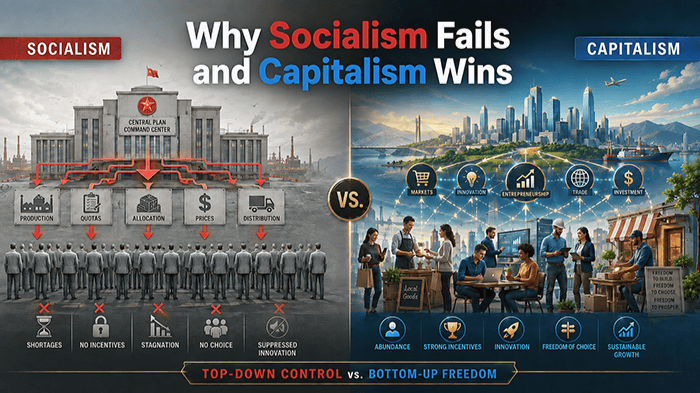
Socialism starts with the collective.
Capitalism starts with the individual.
That difference explains more than almost any policy argument.
Under socialism, society becomes the primary unit. Political authorities decide how resources should be directed, which industries deserve support, how wealth should be distributed, what outcomes are acceptable, and which goals should take priority.
The individual becomes part of a larger plan.
His work, property, ambition, and choices become instruments of a political vision.
Capitalism reverses the relationship.
You choose your work. You choose what to produce. You choose what to buy.
You choose whether to save, invest, start a business, change careers, accept a job, reject an offer, or walk away from a deal.
Millions of people make millions of separate decisions every day.
Prices, profits, losses, contracts, competition, and voluntary exchange coordinate those choices.
No central planner knows everything. No committee knows what everyone should want.
No political office can see all local needs, changing preferences, hidden costs, personal ambitions, technical details, and tradeoffs scattered across millions of individual minds.
That is one reason socialism repeatedly runs into the same problem.
Central authorities lack the knowledge that only individuals possess in context.
Prices are not arbitrary numbers. They are signals. They communicate scarcity, demand, opportunity, and error.
Profits are not merely private gain. They signal that value has been created.
Losses are not merely misfortune. They signal that resources may be better used elsewhere.
When political authorities override prices, suppress profits, socialize losses, or direct production according to political goals, they weaken the feedback system that makes rational economic coordination possible.
Then the incentive problem appears.
People create, improve, save, invest, and take risks when they can act on their judgment and benefit from the value they produce.
When reward is detached from effort, ownership is weakened, losses are shifted, and outcomes are politically assigned, productive energy declines.
Socialism does not eliminate self-interest.
It redirects self-interest toward politics.
Instead of asking, “What can I produce that others will voluntarily value?” people begin asking, “Who controls the allocation, and how do I influence them?”
That leads to the next problem.
Economic power gathers in political hands.
When government controls production, employment, investment, property, capital, prices, or access to important goods, economic dependence becomes political dependence.
If the state controls your job, your housing, your industry, your permit, your capital, or your access to necessities, disagreement becomes costly.
Political power becomes economic power.
Capitalism spreads power outward.
A business owner must persuade customers. An employee must persuade an employer. An employer must persuade workers.
A seller must persuade buyers. A buyer remains free to refuse.
No system removes bad judgment, fraud, failure, envy, irresponsibility, or corruption.
Capitalism does not require perfect people.
That is one of its strengths.
It gives individuals room to choose, succeed, fail, learn, rebuild, compete, exit, and try again.
Customers can leave.
Workers can change jobs.
Investors can withdraw capital.
Competitors can challenge incumbents.
Entrepreneurs can test better ideas.
Losses can discipline error.
Profits can reward value creation.
Capitalism contains correction mechanisms.
Socialism relies on political authority to organize economic life from the top down.
Capitalism lets individuals organize their own lives from the bottom up.
That is why socialism keeps struggling with stagnation, shortages, weak incentives, distorted information, and concentrated power.
And that is why capitalism keeps producing something socialism struggles to provide:
Freedom for the individual to act.
What About Democratic Socialism?
Democratic socialism differs from authoritarian socialism in one important respect: it seeks socialist goals through elections and democratic institutions rather than dictatorship.
That difference matters politically. But it does not erase the central economic question.
Who owns property? Who directs production? Who allocates capital? Who sets prices? Who decides how resources will be used? Who bears losses when plans fail?
Democracy answers one question: how rulers are chosen.
It does not answer whether rulers should control economic life.
Voting does not solve scarcity.
Voting does not create knowledge that planners do not possess.
Voting does not eliminate incentives.
Voting does not prevent political power from becoming economic power.
The more economic decisions move from individuals and markets to political institutions, the more the basic problems of socialism remain.
The issue is not whether the planners were elected.
The issue is whether anyone should have that much power over the productive lives of others.
For now, the central question remains:
Should economic life be directed by collective authority, or by free individuals acting through judgment, ownership, exchange, and consent?
Sources & Notes
The factual and historical claims in this article were checked against the following sources. The interpretation and argument are the author’s.
- Democratic Socialists of America: What Is Democratic Socialism?
- Library of Congress: Internal Workings of the Soviet Union
- OECD Economic Survey: Korea 2026
- World Bank: China
Key Idea
The core contrast is collective economic direction versus individual judgment, ownership, exchange, and consent.
Read Next
What About Democratic Socialism?
Related Articles
Continue exploring
Individual Capitalism is a connected Library. Follow the next article, explore a Reading Path, or browse the complete collection.

