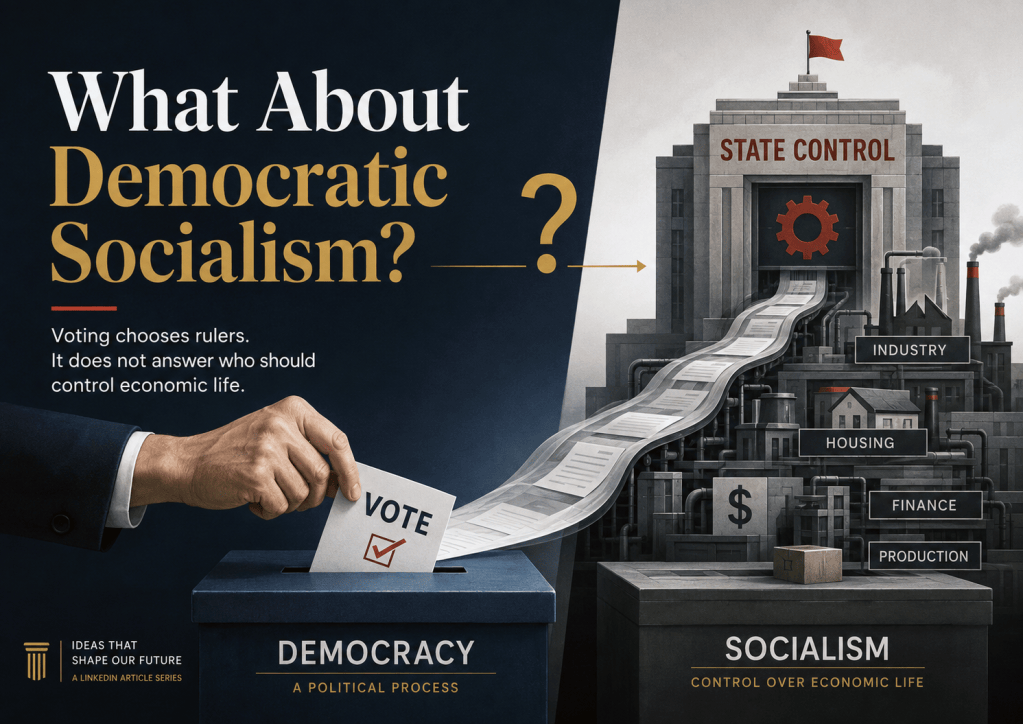
Whenever socialism’s historical record comes up, one response appears quickly:
“That wasn’t democratic socialism.”
The distinction matters. Democratic socialists claim to reject dictatorship and favor elections, civil liberties, political parties, and constitutional government.
But a deeper question follows:
What does adding the word “democratic” change about socialism itself?
Democracy Describes the Political Process
Democracy tells us how political leaders gain power. Socialism tells us how economic power is organized. Those are different questions.
A government might gain authority through free elections and still control property, production, investment, employment, prices, and wealth.
Voting answers how rulers are chosen. It does not answer whether they should control economic life.
What Democratic Socialism Seeks
Democratic socialism goes beyond a welfare state. Its traditional goal is significant social ownership or democratic control of productive property.
Major industries, finance, utilities, transportation, housing, health care, or other sectors might come under public, cooperative, worker, or other collective ownership.
The Democratic Socialists of America (DSA) makes this distinction clear. Its current materials go beyond higher taxes and larger welfare programs, calling for collective ownership of key economic drivers and a vision that moves beyond historic social democracy.
That separates democratic socialism from social democracy.
Social Democracy Is Different
Sweden, Denmark, Norway, Finland, and similar countries often get incorrectly called socialist.
They have large welfare states, high taxes, strong unions, and extensive government benefits.
Yet their economies still depend on private property, private companies, investment, profit, markets, entrepreneurship, and trade. Volvo is not owned by the Swedish government. LEGO is not owned by the Danish government. Novo Nordisk operates for profit.
These countries redistribute wealth generated largely through market economies.
So, the Nordic welfare state rests on a productive market economy. That is social democracy.
Democratic socialism seeks something more fundamental. It seeks to change who owns or controls productive capital.
Democracy Does Not Solve the Knowledge Problem
Socialism faces an economic knowledge problem. No government possesses all the information dispersed among millions of individuals.
- What should be produced?
- How much?
- At what price?
- Which businesses should expand?
- Where should investment go?
Markets answer these questions through individual decisions.
Prices communicate information. Profit rewards good judgment. Loss exposes mistakes.
Competition pressures producers to adjust.
Consumers decide what deserves their money.
An election does not replace these processes.
Democracy Does Not Eliminate Incentive Problems
Socialism also faces an incentive problem.
Under capitalism, investors often bear the consequences of their decisions. Good decisions might produce profit. Bad decisions might produce loss.
Political decision-making changes the relationship.
Officials often allocate resources they do not own. Elections, interest groups, bureaucracy, ideology, and political pressure influence their decisions.
A democratic government still has politicians.
A public enterprise still has administrators.
Democracy does not remove error, favoritism, self-interest, or bad judgment.
There Is Also a Power Problem
Capitalism disperses economic power among millions of owners, businesses, workers, investors, and consumers.
Your employer does not control your ballot. Your bank does not write criminal law. Your landlord does not command the police.
Socialism moves more economic authority toward the political system.
As government gains control over employment, capital, credit, housing, production, communications, and investment, economic independence from government shrinks.
Now consider someone who openly opposes those in power.
Who employs him? Who finances his business? Who controls access to capital? Who controls his professional license?
Elections protect against political tyranny.
But elections do not erase the danger created when political and economic power accumulate in the same institutions.
What Happens When the Majority Votes for Control?
Democratic socialism also raises a moral question.
Suppose 51 percent of voters authorize government to take control of property owned by the other 49 percent.
Does the vote transform coercion into voluntary action?
Does majority approval eliminate individual rights?
Democracy is a method for making political decisions.
Individual rights establish limits on government power.
A free society needs both elections and limits.
The key question is not:
“Did people vote for socialism?”
It is: “What did they vote government the power to do?”
What About Mixed Economies?
Every major modern economy is mixed.
The United States is not pure capitalism.
Sweden is not pure capitalism.
China combines Communist Party control with large areas of market activity and private enterprise.
Labels tell us less than institutions.
Ask instead:
- Who owns productive assets?
- How secure is private property?
- Who directs investment?
- Who bears losses?
- How freely do people start businesses?
- How much choice do consumers possess?
- How much economic authority does government exercise?
Those questions reveal more than the labels “socialist” or “capitalist.”
Democratic Socialism Has a Special Challenge
Democratic socialists face a dilemma.
The more private property, markets, investment, entrepreneurship, profits, and consumer choice they retain, the more their system resembles social democracy or regulated capitalism.
The more they replace those institutions with collective ownership and political allocation, the more they encounter socialism’s traditional problems.
Democracy improves how political power is obtained and transferred. It does not eliminate scarcity. It does not create dispersed economic knowledge. It does not replace market prices.
It does not reproduce profit-and-loss discipline. It does not remove political incentives.
And it does not answer the moral question of how much authority society should possess over the individual.
More Questions I Would Ask a Democratic Socialist
I would avoid arguing over labels.
I would ask:
- What do you want government or society to own?
- What private ownership would remain?
- Who decides where investment goes?
- Who decides what gets produced?
- Who sets prices?
- Who absorbs losses?
- Who gets to start a competing business?
- And what prevents political power from becoming economic power?
Those questions move the debate from intentions to institutions and consequences.
Democratic socialism deserves the same test as every economic system.
Not what its advocates hope to accomplish.
But what individuals remain free to own, choose, produce, trade, risk, build, and refuse.
Sources & Notes
The factual and historical claims in this article were checked against the following sources. The interpretation and argument are the author’s.
- Democratic Socialists of America: What Is Democratic Socialism?
- DSA Constitution and Bylaws
- Nordic Cooperation: The Economy in the Nordic Region
Key Idea
Democracy changes how political power is selected, but it does not by itself solve the economic problems of ownership, knowledge, incentives, or concentrated power.
Read Next
Related Articles
Continue exploring
Individual Capitalism is a connected Library. Follow the next article, explore a Reading Path, or browse the complete collection.

