Consider the Philosophical Roots of Anti-Capitalism
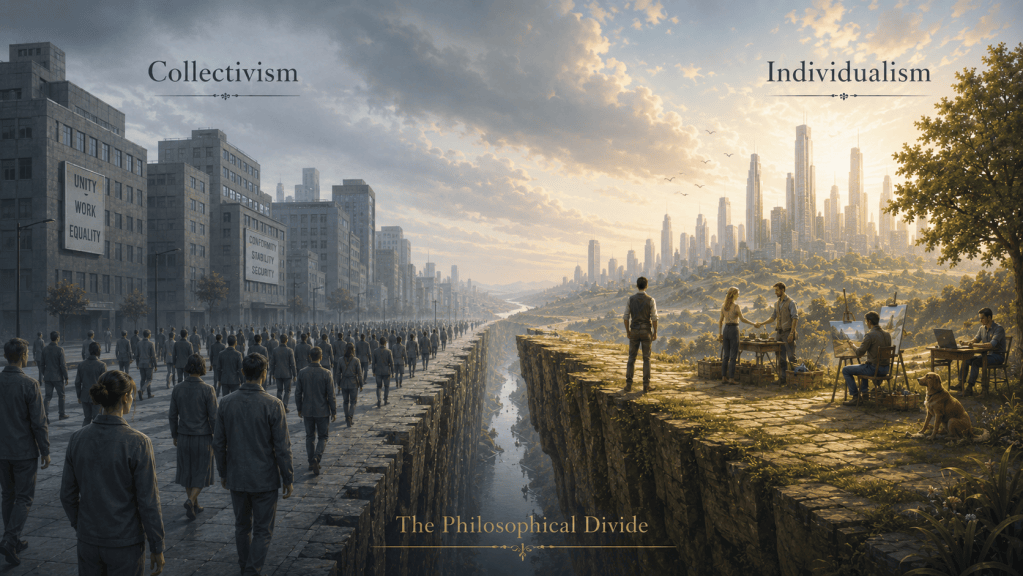
Most criticisms of capitalism focus on inequality, corporations, consumerism, or environmental concerns. Those issues deserve discussion. But beneath them lies a deeper disagreement—not primarily about economics, but about philosophy.
Capitalism begins with a simple moral premise: the individual owns his or her own life. People should be free to pursue their goals, create value, exchange voluntarily, and enjoy the rewards of their effort so long as they respect the equal rights of others.
Many critics reject that premise.
Instead, they view society as the primary moral unit. In this view, the individual exists chiefly to serve the collective—whether defined as society, the state, the nation, humanity, or some higher cause. Individual freedom becomes secondary to collective goals.
This philosophical divide shapes nearly every debate about capitalism.
Capitalism evaluates a system largely by its results: Does it improve lives? Does it expand opportunity? Does it allow people to create, innovate, and prosper?
Its critics often place greater emphasis on intentions. If an action is undertaken in the name of equality, justice, or the common good, its motives are considered morally important, even if the results prove disappointing or sometimes disastrous.
History offers many examples of governments pursuing “noble ideals” through coercive means. Once collective goals are treated as morally superior to individual rights, freedom can become negotiable.
This is why defenders of capitalism place such importance on individual rights. Rights establish limits on political power. They recognize that no person or government has the moral authority to direct another person’s life for supposedly higher purposes.
Another source of tension is capitalism’s unequal outcomes.
A free society guarantees equal rights, not equal results. Different talents, ambitions, decisions, and circumstances naturally produce different outcomes. Critics often see these differences as evidence of injustice, while supporters of capitalism see them as the inevitable consequence of freedom.
The real debate is not whether inequality exists. It is whether individuals should remain free to make different choices and accept different consequences.
Capitalism also challenges a long-standing suspicion of self-interest.
Properly understood, self-interest does not mean exploiting others. It means taking responsibility for one’s own life, creating value, engaging in voluntary exchange, and pursuing success without violating the rights of others. In a market economy, people generally prosper by serving others rather than by controlling them. One “serves” others by trading values in the marketplace. Both parties achieve something they value.
Perhaps that is capitalism’s greatest strength.
Instead of directing millions of lives from the top down, capitalism relies on countless independent decisions made every day by free individuals. No central planner possesses enough knowledge to coordinate an economy as effectively as millions of people acting on local knowledge, personal goals, and voluntary cooperation.
Ultimately, the debate over capitalism is a debate about human nature.
Do individuals exist primarily to serve society, or does society exist to protect the freedom of individuals?
Should government direct economic life, or should people be free to pursue their own ambitions?
Should success be viewed with suspicion, or as evidence that value has been created?
How one answers those questions determines how one views capitalism.
The case for capitalism is not simply that market-oriented economies have generated extraordinary increases in wealth and living standards.
The deeper case is that it respects human dignity by recognizing each person’s right to think, choose, create, own, trade, and flourish.
Key Idea
The dispute over capitalism rests on deeper philosophical questions about whether the individual or the collective is the primary moral unit.
Read Next
Why Socialism Fails and Capitalism Wins
Related Articles
Continue exploring
Individual Capitalism is a connected Library. Follow the next article, explore a Reading Path, or browse the complete collection.

